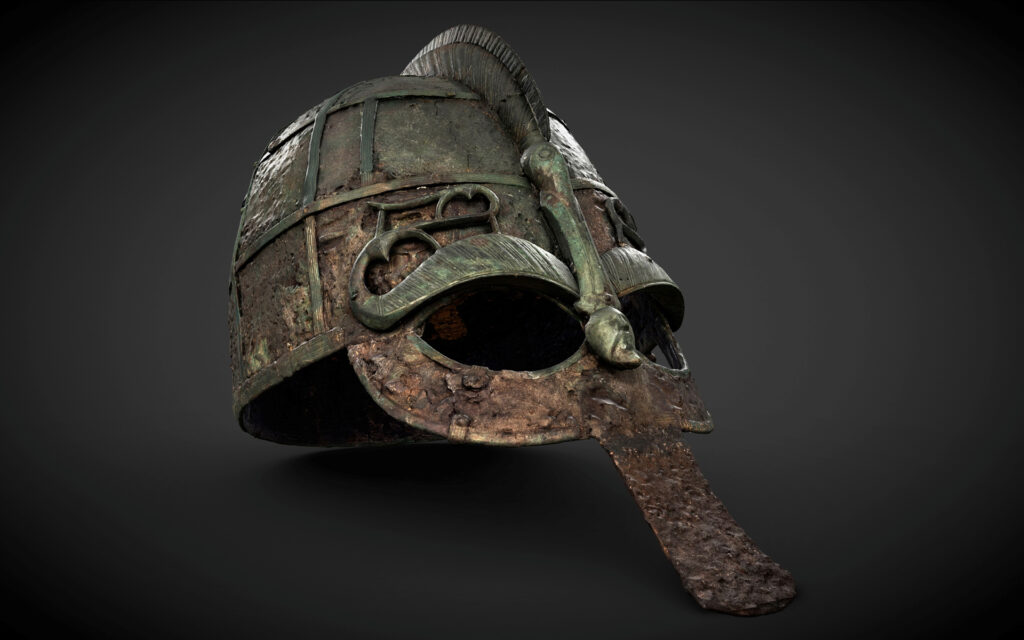
To highlight the importance of 3D in the preservation and reuse of cultural heritage, EU member states have been invited to submit at least one high-quality digitised object to the data space for cultural heritage as part of the Twin it! campaign. Sweden’s contribution in 2026 are the three remarkable helmets found in graves I, XII and XIV at the burial site Vendel, which has given name to the Iron Age period they defined (ca 550-750 CE). The intricate features and decorations on these helmets can now be studied in close detail by everyone, from any angle.
The models are made accessible through the Swedigarch research infrastructure, in collaboration between teams at the National Historical Museums and DARKlab at Lund University. The helmets are presented in Dynamic Collections where it is possible to analyse them with digital tools (see links below). The models can also be downloaded via the Swedigarch Community on Zenodo.
The helmets are also findable on Europeana, the public interface for the data space. The aggregator SOCH (K-samsök), maintained and developed by the National Heritage Board, acted as the final link in the chain by enabling the delivery of the data from the collections onto the Europeana platform.
In addition to the helmets being a good example of how 3D models can be made accessible and useful for research, Sweden’s contribution also shows the importance of collaboration between museums, universities, and national agencies to ensure access to our shared heritage.
Resources and published materials
The Vendel helmets on the Europeana platform
The Vendel helmets in Dynamic Collections:
- Vendel I helmet: https://dyncoll.ht.lu.se/artifact_view.php?item=847
- Vendel XII helmet: https://dyncoll.ht.lu.se/artifact_view.php?item=849
- Vendel XIV helmet: https://dyncoll.ht.lu.se/artifact_view.php?item=848
More Vendel burial site artefacts in the History Museum’s collections
The 3D models and other assets on the Swedigarch Community on Zenodo:
Contact for questions:
Elin Fornander, Head of Research, National Historical Museums (elin.fornander@shm.se)